Temporary Cooling When Operations Cannot Stop
Commercial HVAC Rental and Emergency Services in Milltown for equipment failures and planned capacity needs
Equipment failures and planned shutdowns create urgent cooling demands in commercial and industrial environments, and standard replacement timelines often extend weeks beyond what facility operations can tolerate. Rylee Mechanical provides rental chillers, temporary air conditioning units, and emergency mechanical response for facilities across New Jersey, New York, and Pennsylvania, while rental HVAC services extend to customers nationwide who need specialized commercial cooling equipment on short notice. Rental equipment bridges the gap between failure and permanent repair, supports capacity during peak demand periods, and maintains critical cooling when planned maintenance takes primary systems offline.
Services include emergency mechanical response for sudden equipment failures, rental chiller deployment for temporary cooling needs, air-cooled and water-cooled rental units sized for commercial applications, and planned rental arrangements that support shutdowns, transitions, or seasonal capacity requirements. Response coordination addresses equipment selection, installation logistics, utility connections, and integration with existing mechanical infrastructure.
Contact our emergency line immediately if critical cooling equipment has failed and facility operations are at risk.
How Rental Equipment Supports Commercial Operations
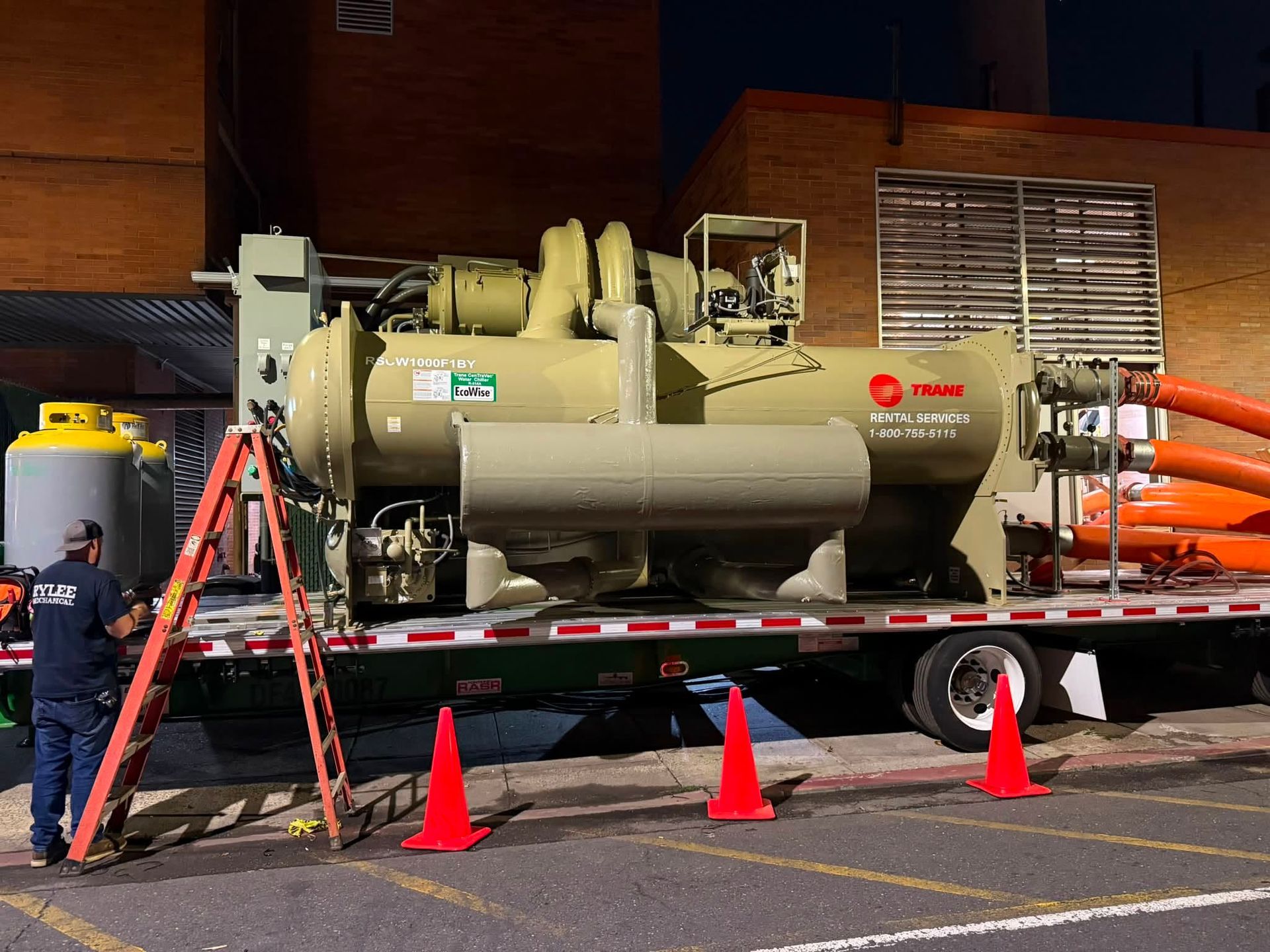
Deployment begins with evaluating cooling load requirements, confirming electrical service capacity and connection points, identifying placement locations with adequate clearance and access, and coordinating delivery and installation timelines that match facility urgency. Rental units are connected to existing chilled water loops, ductwork, or process cooling systems depending on application type, and controls are integrated so facility staff can monitor and adjust operation without requiring constant contractor presence.
Facility managers notice that temperatures stabilize quickly after rental equipment is installed, critical processes resume without further delays, and operations continue normally while permanent repairs or replacements are planned and executed. Rental units operate quietly compared to undersized emergency measures, and cooling capacity remains consistent even during extended deployment periods that stretch across weeks or months.
Planned rentals allow facilities to schedule maintenance without sacrificing climate control, support temporary capacity increases during high-occupancy events, and provide backup cooling during construction projects that affect primary mechanical systems. Equipment is removed and primary systems are restored once permanent work is completed and commissioned.
What Clients Ask About Rental Services
Facility teams facing equipment failures or planning temporary cooling needs often have questions about response times, equipment capabilities, and coordination logistics before committing to rental deployment.
What types of commercial cooling equipment are available for rental?
Options include air-cooled chillers, water-cooled chillers, spot cooling units, process cooling systems, and temporary air conditioning equipment sized for commercial and industrial applications, with capacity ranging from small server room units to large tonnage chillers that support entire buildings.
How quickly can rental HVAC equipment be deployed after an emergency call?
Response time depends on equipment availability, travel distance to the facility, and complexity of installation requirements, with local deployments in Milltown and surrounding New Jersey areas often completed within hours while larger units or distant locations may require coordination over one to two days.
Why does rental equipment need integration with existing mechanical systems?
Rental chillers must connect to facility chilled water loops, electrical service, and building controls so that cooling is distributed through existing ductwork or piping rather than requiring temporary distribution systems, and proper integration ensures that facility staff can operate the equipment without constant contractor support.
What information does Rylee Mechanical need to arrange a planned rental in Milltown?
Facilities should provide cooling load estimates or current equipment tonnage, electrical service specifications, available placement locations with clearance dimensions, preferred installation timeline, and anticipated rental duration so equipment selection and logistics can be coordinated accurately.
How are rental costs structured for commercial HVAC equipment?
Pricing depends on equipment size, rental duration, delivery distance, installation complexity, and whether utility connections or control integration require additional labor, with planned rentals often structured differently than emergency deployments that demand immediate response regardless of scheduling convenience.
Rylee Mechanical responds to commercial and industrial cooling emergencies and coordinates planned rental equipment deployments for facilities nationwide. Contact our emergency line for urgent cooling failures, or reach out separately to discuss planned rental needs, temporary capacity requirements, or backup cooling strategies for upcoming maintenance projects.